Strong in Maths and Science? How to Choose Between MPC and Polytechnic After Class 10
Everyday examples help students who enjoy Maths and Physical Science and their parents decide whether to explore engineering through MPC or choose a technical branch right after Class 10 with a polytechnic diploma.
SUNKARA RAJESH ·
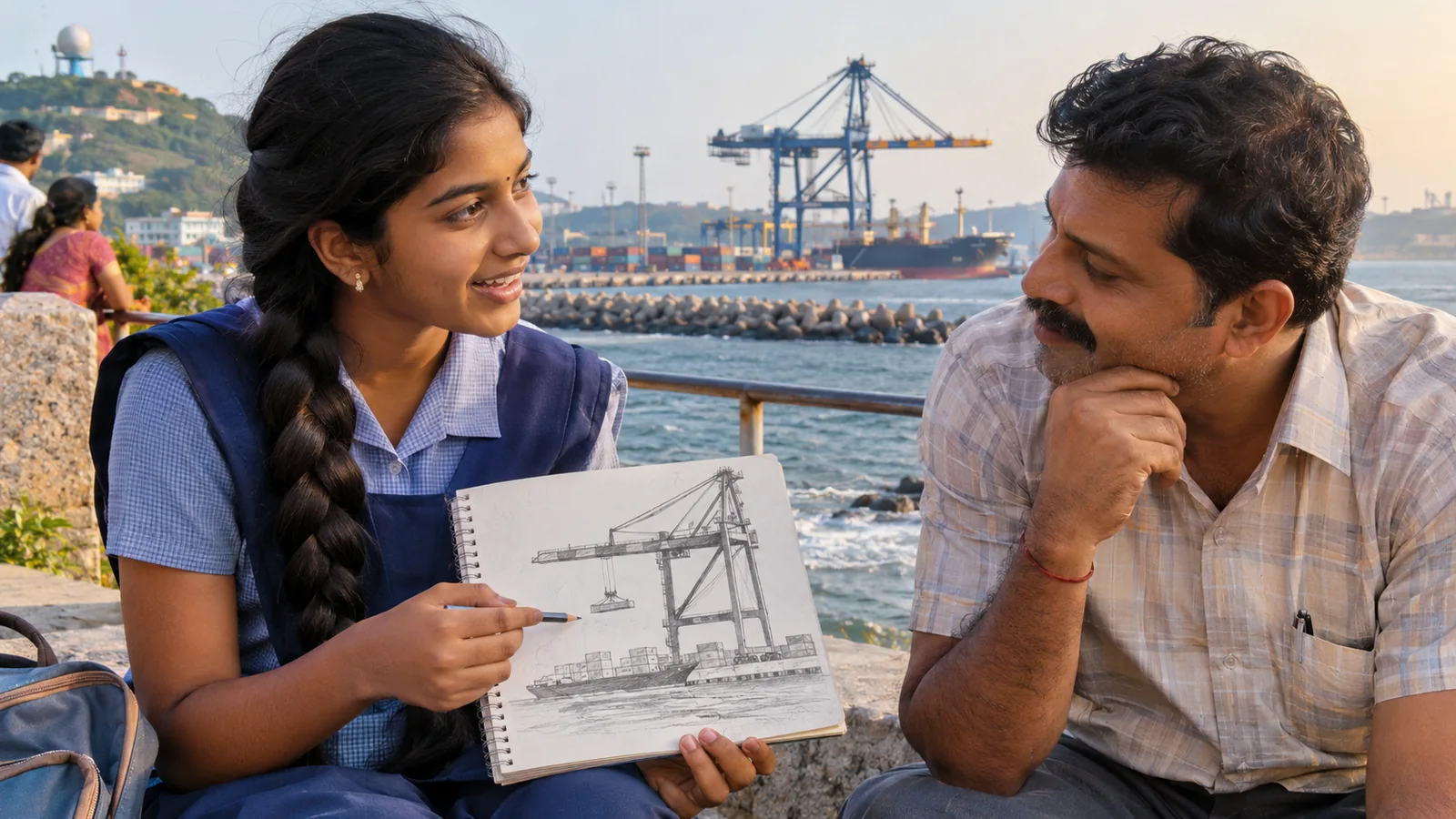
Look at a cargo crane at Visakhapatnam harbour. As its long arm reaches over a ship, one student wonders, “Why doesn’t the crane tip forward?” Another reaches for a notebook and starts sketching the cables and pulleys. If you enjoy Maths and Physical Science, which question would you ask first?
After Class 10, that curiosity can help you choose between two routes. Intermediate MPC gives you two more years to study Mathematics, Physics and Chemistry before choosing a degree. A polytechnic diploma lets you start exploring a particular engineering branch through theory, labs and workshop practice. Here is what each choice could look like for you.
Where does your curiosity take you?
The ceiling fan that changes the electricity bill
Imagine your family is choosing between a 75-watt fan and a 35-watt fan. Both would run for eight hours a day. How much electricity could the second fan save? The difference is 40 watts. Over 30 days, that adds up to 9.6 units of electricity. You can use the per-unit rate on your family’s bill to estimate the monthly saving.
Now imagine your father asks, “Will it keep the room just as cool?” Suddenly, wattage is only part of the decision. You also want to know how much air each fan moves. If you enjoyed working out the saving, you might like the mathematical side of physics. If you want to understand how a motor and its blades deliver that airflow, take a closer look at electrical or mechanical engineering.
The puddle outside your school gate
After heavy rain, one side of the school gate floods while the other stays clear. Before suggesting a solution, what would you check? You might sketch the road, mark the nearest drain and look at which way the ground slopes. Is the drain blocked? Does the water collect at a point lower than the drain opening?
That is a small example of civil engineering. The interesting part is deciding what to measure before you decide what to build. If you enjoy geometry, scale drawings and solving problems you can see in your neighbourhood, Civil Engineering is a branch worth exploring.
What would you study in MPC?
In Andhra Pradesh, MPC stands for Mathematics, Physics and Chemistry. It may suit you if you enjoy algebra, want to understand topics such as motion and electricity, and would like more time before selecting a field. Chemistry is a significant part of the course, so look through a first-year chapter in all three subjects before deciding.
Think back to the crane. In physics, you might investigate why moving a load farther from its support changes its turning effect. If working through that question leaves you wanting a harder one, MPC may be a good fit. After Intermediate, you can explore engineering or degrees in subjects such as mathematics and physics, depending on admission requirements.
What would you study in a polytechnic diploma?
In a polytechnic, you choose a branch when you join. Many engineering diplomas take three years after Class 10. Your studies combine technical theory, calculations and practical work. A useful question to ask is, “Which kind of problem would I like to spend several semesters working on?”
- Mechanical Engineering: How do the gears, pulleys and brakes in a lifting machine work together?
- Electrical Engineering: How does an electric motor turn electrical energy into movement?
- Electronics and Communication Engineering: How can a sensor detect movement and send a signal to a controller?
- Civil Engineering: How do engineers measure a site, draw a plan and design drainage?
In Andhra Pradesh, AP POLYCET is an admission route for polytechnic diplomas. A diploma can lead towards technician roles or further study. Eligible diploma holders can also seek admission to the second year of B.E. or B.Tech through AP ECET, subject to the applicable branch and admission rules.
A ten-minute activity for students and parents
Place two books a short distance apart and lay a sheet of paper across the gap. Add identical coins, one at a time, until the paper bends. Now fold the same sheet like an accordion, keep the gap unchanged and repeat. How many coins can it hold this time?
Students: What would you try next? You could record the results, change the width of the folds or draw the bridge from the side to understand why its shape matters. Parents: Ask your child to explain their next experiment. The part they choose to explore can start a more revealing conversation than asking which course their friends have selected.
How can your family make the final choice?
If you enjoy several subjects and want time to decide which field to pursue, consider MPC. If one engineering branch already interests you and you want to study it through calculations, drawings and practical assignments, explore a polytechnic diploma in that branch.
Before applying, visit a junior college and a polytechnic together. At the junior college, ask to see a first-year MPC timetable and a typical assignment. At the polytechnic, ask a student to show you a lab record or workshop project and explain what they found difficult. On the way home, ask each other one question: “Which piece of work did you want to stay longer and understand?”
Intermediate MPC or a Polytechnic Diploma After Class 10?
| What to consider | Intermediate MPC | Polytechnic engineering diploma |
|---|---|---|
| What you choose now | You choose Mathematics, Physics and Chemistry. You can decide on a degree or engineering branch later. | You choose an engineering branch when you join, such as Civil, Mechanical, Electrical or Electronics Engineering. |
| What learning looks like | You solve equations, explain physical principles, study chemistry and carry out laboratory experiments. | You study maths and technical theory, then apply them through drawings, lab assignments or workshop projects specific to your branch. |
| Usual duration in Andhra Pradesh | Two years. | Three years for many engineering diplomas. |
| What can follow | You can apply for engineering degrees or degrees in mathematics or physical sciences, depending on the course eligibility and admission requirements. | You can pursue technician roles or continue studying. In Andhra Pradesh, eligible diploma holders can seek second-year B.E. or B.Tech admission through AP ECET, subject to branch and admission rules. |